
Every organization is on a cyber odyssey. The threats may look mythical, but the risks are deeply human.
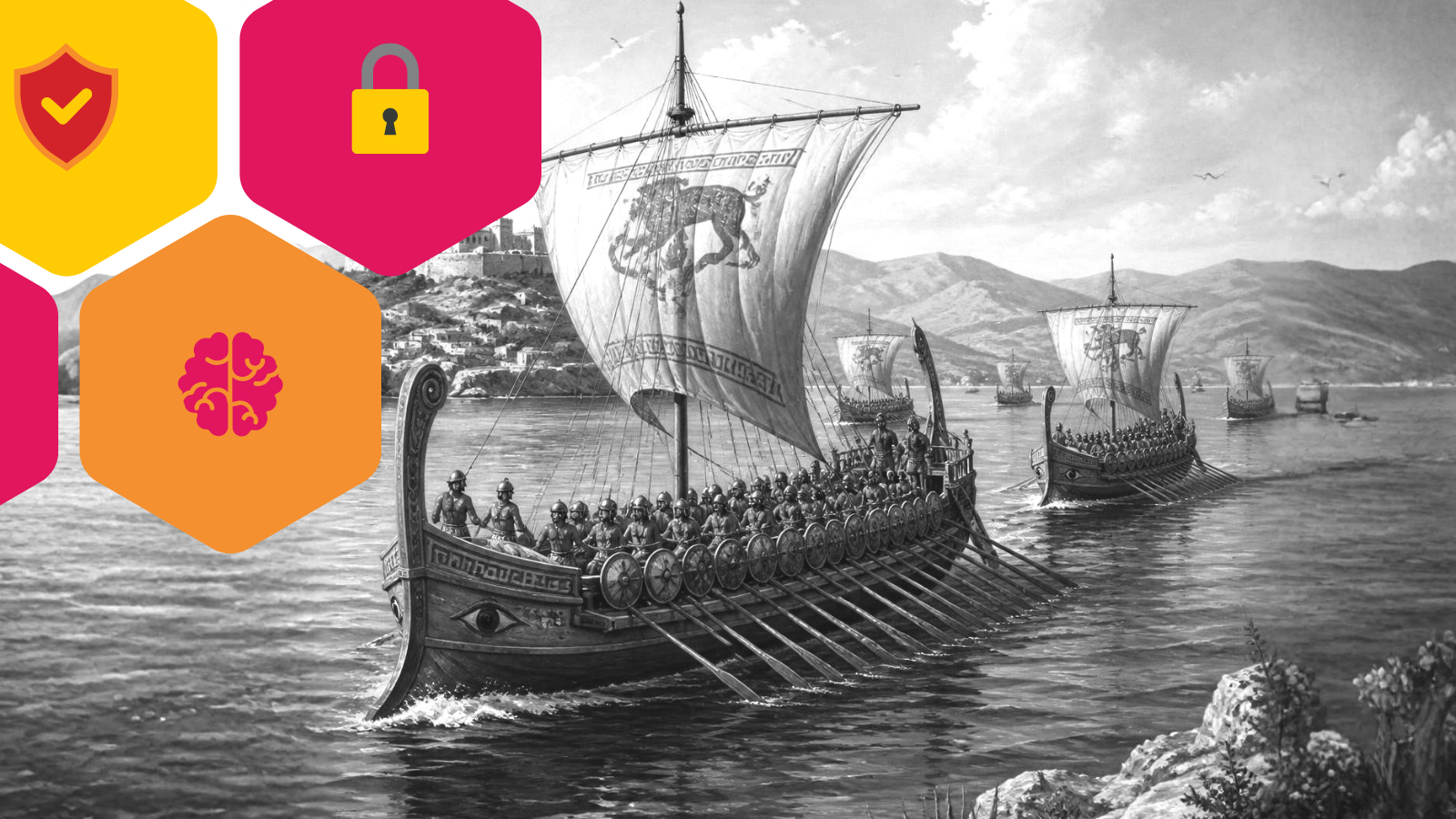
"Tell me, O muse, of that ingenious hero who travelled far and wide" — so opens Homer's Odyssey, nearly three thousand years before anyone coined the phrase "human risk management." The line still fits. The modern organization is a ship in unpredictable waters, and its destination may be growth, innovation, resilience, digital transformation, or the safe adoption of artificial intelligence. Its crew includes employees, leaders, contractors, partners, developers, administrators, and increasingly, autonomous or semi-autonomous technologies acting on their behalf.
The voyage is rarely straightforward. There are hidden dangers, persuasive voices, compromised identities, powerful insiders, poor decisions made under pressure, and technologies that promise to make the journey easier while introducing risks nobody fully understands.
That is what makes The Odyssey such a useful lens for modern cybersecurity. It isn't a story about one battle or one enemy. It's a long journey shaped by intelligence, temptation, pride, exhaustion, trust, human error, and the consequences of decisions that seemed reasonable at the time.
The monsters may be mythical. The risks are deeply human.
The Modern CISO as Odysseus
At the center of the story is Odysseus: strategist, navigator, problem-solver, and occasionally the source of his own difficulties. He's an obvious stand-in for the modern CISO — expected to guide an organization through threats that keep changing shape, balance protection with progress, and make decisions without ever having complete information.
But Odysseus is not a perfect hero. He's intelligent, experienced, and inventive — and also proud, curious, and sometimes convinced he can outthink every threat. That makes the metaphor more useful, not less.
What the data says about "one brilliant leader" as a strategy:
- Human factors play a role in the large majority of breaches, year after year, per Verizon's Data Breach Investigations Report
- No single strategist, however capable, catches every failure mode alone
- Even the most capable CISO needs a prepared crew, reliable intelligence, and controls that keep working when judgment is under pressure
Reality check: if your risk program still depends on one brilliant person catching everything before it lands, you don't have a program. You have a hero with a deadline.
The goal is not to defeat every monster personally. It is to get the organization home safely.
Act I: Deception and Temptation
Some threats attack the walls. Others persuade us to open the gates. The first act of the Cyber Odyssey is about risks that attract, disguise, transform, or quietly weaken human judgment.
The Sirens: When Deception Sounds Irresistible
The Sirens do not sound suspicious. In Homer's telling they call to Odysseus by name, promising exactly what a war-weary man most wants to hear: "Come here, renowned Ulysses, and listen to our two voices." No threats, no trickery visible on the surface — just a voice that knows precisely what you're hungry for.
In the modern organization, that voice arrives through personalized phishing, executive impersonation, deepfake audio, business email compromise, malicious prompts, or an AI tool promising to solve an urgent problem.
Why the old advice doesn't hold anymore:
- The FBI's Internet Crime Complaint Center has tracked AI-enabled fraud and impersonation losses climbing into the hundreds of millions annually
- Business email compromise alone continues to generate billions in losses despite years of awareness training
- "Does this look suspicious?" is no longer a reliable test — the Sirens have gotten better at sounding exactly right
How Odysseus actually survives
He doesn't assume he'll recognize the danger in the moment. He prepares before exposure: the crew's ears are blocked, he is tied to the mast, and the procedure is established before persuasion begins.
When persuasion is the attack, verification must be the control.
Organizations can't rely on employees simply having better instincts than the attacker. They need trusted verification channels, a norm of pausing, and explicit permission to challenge even convincing requests.
Reality check: the "just trust your gut" era of phishing awareness is over. Attackers have your gut's number now too.
The Trojan Horse: When Risk Arrives as a Gift
The most dangerous threat may not break through the organization's defenses. It may be welcomed inside because it appears useful — a software update, vendor integration, browser extension, trusted account, AI assistant, shared application, or productivity tool installed by someone trying to get work done faster.
The bard Demodocus sings the story of the wooden horse in Odysseus's own presence, and even Odysseus — the man who built the thing — weeps at the memory of how easily Troy welcomed it in. Familiar packaging fooled a city that had survived ten years of siege. It will fool an organization that trusts too quickly, too.
Before opening the gates, ask:
- What permissions has the tool been granted?
- What data can it reach, and what else can it connect to?
- What happens if the vendor, account, update process, or underlying model is compromised?
- How quickly could it be contained if something changed?
Familiar packaging does not make something safe.
Trust should not eliminate scrutiny — it should define what must be verified and monitored.
Reality check: yes, this includes the browser extension your marketing team installed last Tuesday to save fifteen minutes on formatting.
Circe: When Trusted Systems Become Something Else
Circe does not destroy Odysseus's crew. She transforms them — and they still look, to any outside observer, like themselves.
Modern attackers often do the same. A compromised account may still look familiar while behaving for someone else. A trusted workflow may be manipulated. An AI agent may continue performing its assigned task while acting on poisoned data or excessive permissions.
This is also a useful lens for AI adoption. The transformation itself is not necessarily dangerous — the risk emerges when it happens without visibility, boundaries, accountability, or meaningful human oversight.
The questions worth asking about every AI tool in the building:
- Who can instruct it?
- What information can it reach?
- Which decisions can it influence?
- What happens when its behavior changes?
A system does not need to look broken to be compromised.
Sometimes the most dangerous transformation is the one that leaves the familiar surface intact.
The Lotus-Eaters: When the Mission Stops Feeling Important
Not every threat creates fear. Some simply make people stop paying attention. The lotus doesn't attack Odysseus's crew — it offers comfort, distraction, and relief from the difficult journey ahead.
Cyber complacency works in much the same way. It sounds like:
- "We passed the audit."
- "Everyone completed the training."
- "We've never had a serious incident."
- "The dashboard is green."
- "People already know this."
Over time, repeated warnings lose their impact. Security messages become background noise. Leaders mistake completed activity for reduced risk.
The answer is not to keep the organization permanently afraid. It is to keep the mission meaningful — interventions that are relevant and proportionate, secure behavior that's easier rather than endlessly more burdensome, and measurement that shows whether capability and behavior are actually changing.
Comfort is not evidence of resilience.
Reality check: a green dashboard has never once stopped a breach. It has, however, stopped a lot of budget conversations that needed to happen.
Act II: Access, Power, and Consequence
The second act explores what happens when power becomes concentrated, access becomes entitlement, policy collapses under pressure, and the consequences of earlier decisions refuse to disappear.
The Cyclops: Power Without Safeguards
The Cyclops is immensely powerful, isolated, and convinced nobody can challenge him. His strength is concentrated in one place. So is his weakness.
Organizations create their own Cyclopes when critical power sits with one administrator, one shared account, one supplier, one system, one AI model, or one person who holds all the institutional knowledge. Concentrated power creates fragility.
Odysseus also defeats the Cyclops through an identity trick. Cornered and asked his name, he answers, simply: "My name is No Man." When the Cyclops later howls for help, screaming that "No Man" is attacking him, his neighbors shrug and walk away — how do you defend against an attacker who officially doesn't exist?
In the modern organization, "no one" should never own:
- An account
- A system
- A decision
- A risk
Power without safeguards creates vulnerability. Power without ownership creates chaos.
The Suitors: When Access Becomes Entitlement
The Suitors do not break into Odysseus's home. They are already inside — occupying the palace, consuming its resources, ignoring its boundaries, and behaving as though continued access is their right.
Insider risk often looks less like a dramatic intruder and more like access that was never reviewed or removed:
- An employee changes roles but keeps old permissions
- A contractor completes a project but retains system access
- A dormant account remains active
- A departing employee takes data they believe they helped create
Access granted for one purpose can become entitlement when nobody revisits it. Effective governance requires strong joiner, mover, and leaver processes; regular access reviews; clear ownership; and the ability to spot unusual use of trusted resources.
The question is not only, "Should this person have access?" It is also, "Should they still have it now?"
Poseidon: The Risk That Keeps Returning
Poseidon is not a single event. He is the continuing consequence of an earlier action — Odysseus escapes the Cyclops, but the decision he makes afterward ensures the consequences follow him across the sea, for years, for the rest of the poem.
Cyber incidents often have the same long tail. IBM's Cost of a Data Breach research has repeatedly found that a meaningful share of breach costs land in the months and years after containment — regulatory fines, litigation, customer churn, and the quiet cost of an organization that never fully trusted its own systems again.
The initial breach may be contained, but exposed credentials remain active. Technical debt persists. Attackers return through the same weakness. The organization closes the incident but never fully resolves the condition that allowed it to happen.
Incident closure is not the same as risk resolution.
Reality check: if your post-incident report and your pre-incident risk register look identical, nothing actually got fixed. You just filed some paperwork.
The Bag of Winds: When Secrecy Creates Risk
Aeolus gives Odysseus a bag containing the winds and warns him to keep it closed. The crew doesn't understand what's inside — they assume Odysseus is hiding treasure. So they open it, and the ship that was almost home is blown right back out to sea.
This is usually framed as a story about careless or disobedient people. But it's also a failure of communication and trust. People cannot protect what they do not understand.
When employees encounter unexplained restrictions, they invent their own explanations:
- Why can't I use this tool?
- Why is this file restricted?
- Why does this action require approval?
- Why can't I paste this into an AI assistant?
Good governance explains the purpose of controls, labels sensitive assets clearly, limits access proportionately, and provides safe alternatives. It doesn't require every employee to become a security expert — it gives them enough context to understand what's at stake.
Security should not make curiosity the enemy. It should prevent uncertainty from becoming the vulnerability.
The Cattle of Helios: When Knowing the Rule Is Not Enough
Odysseus's crew knows the rule. They've been warned not to touch the sacred cattle, and they understand the consequences — Circe herself told them plainly what would happen: "I forewarn you of the destruction of your ship and your comrades." They break the rule anyway. They are hungry, isolated, under pressure, and no longer believe they have a workable alternative.
This may be one of the most important human risk lessons in the entire Odyssey.
People do not always behave unsafely because they lack awareness. They may know exactly what the policy says and still share a password, bypass an approval, upload sensitive data into an unapproved tool, or ignore a warning to complete urgent work. The problem isn't always knowledge — it's that the safe action is too difficult, too slow, unavailable, or incompatible with real working conditions.
Policy awareness is not the same as policy viability.
Reality check: if the compliant path takes forty minutes and the risky path takes four, don't be surprised which one people choose at 4:57 on a Friday. That's not a training failure. That's a design failure wearing a training costume.
Act III: Navigation and Resilience
The final act is not about avoiding every danger. It's about seeing clearly, making better decisions, learning from the past, and preserving the ability to recover.
Scylla and Charybdis: Choosing Between Risks
Odysseus must navigate between two dangers. Avoiding one completely can drive the ship directly into the other — Circe's advice is blunt: "you had better lose six men than your whole crew." Not a comfortable choice. A necessary one.
Cyber and AI governance leaders face similar tradeoffs every day:
- Block every new AI tool, and shadow AI grows
- Allow everything, and sensitive data spreads into systems nobody can govern
- Add too much friction, and employees build workarounds
- Remove too much friction, and unsafe actions become effortless
Security leaders rarely choose between risk and no risk. They choose between different forms of risk. Good governance makes those tradeoffs explicit, defines acceptable boundaries, offers secure alternatives, and changes course when the evidence demands it.
The goal is not a mythical route with no danger. It is a navigable route through it.
The Underworld: Learning from What Already Happened
Odysseus descends into the Underworld because he cannot find the way forward without consulting the past. Organizations cannot build resilience if every incident is closed, forgotten, and repeated.
Incident reviews, forensic evidence, threat intelligence, and the knowledge of experienced people all contribute to organizational memory — but those lessons only create value when they change what happens next.
Ask, after every incident:
- Did the organization update the control?
- Did the team change the process?
- Did the affected employees receive support?
- Did leaders understand the conditions that shaped the behavior?
Blameless learning doesn't mean removing accountability. It means looking beyond the nearest human error to understand the environment, pressures, systems, and decisions that made the event possible.
To navigate what comes next, organizations must be willing to confront what already happened.
Athena: Intelligence That Improves Judgment
Athena does not complete the journey for Odysseus. She provides insight, perspective, and intervention when it matters — that is what effective risk intelligence should do.
Organizations rarely suffer from a complete lack of data. They suffer from disconnected evidence, unclear priorities, and uncertainty about which signal deserves action. Good human risk intelligence helps leaders understand what has changed, who is affected, whether the evidence is sufficient, which intervention is appropriate, and what should happen next.
It does not replace human judgment. It makes better judgment possible.
Reality check: more dashboards is not the same as more insight. Athena doesn't hand Odysseus a hundred data points and walk away. She tells him the one thing he needs to know, right when he needs to know it.
Penelope's Weaving: Creating Time to Verify
While Odysseus navigates the sea, Penelope faces pressure at home. She promises to make a decision when her weaving is complete, then unravels the work each night. Through controlled delay, she creates time and preserves her ability to act.
Modern attackers deliberately create urgency because urgency reduces scrutiny — the payment approved now, the credentials shared now, the unusual request completed before anyone checks.
Penelope's lesson is that delay is not always indecision. Sometimes it's a security control. Resilient organizations give people explicit permission to pause, verify, escalate, and resist forced urgency.
A few minutes of verification can prevent months of recovery.
Argos: Recognizing What Others Miss
When Odysseus finally returns home in disguise, almost nobody recognizes him. Argos, his old hunting dog — grown feeble, neglected, forgotten by everyone in the palace — does. Homer gives it to us in a single, quiet gesture: "he dropped his ears and wagged his tail." Nothing more dramatic than that. Nobody else in the room even notices.
In cybersecurity, credentials may say an identity is legitimate while behavior suggests something has changed — an unusual login time, a slightly wrong tone in a message, a trusted account moving data differently than it used to.
Anomaly detection isn't only about sophisticated automation. It's also about behavioral baselines, organizational knowledge, and giving people routes to report weak signals before they become obvious incidents.
Sometimes familiarity detects what credentials cannot.
The Route Home
The Odyssey does not offer one monster, one control, or one simple answer. Neither does modern human risk.
Organizations need more than annual awareness activity. They need the ability to understand changing risks, detect meaningful signals, develop human capability, guide decisions at the right moment, govern new technologies, and measure whether their interventions actually work. That requires a connected approach across the full human risk lifecycle — one that treats employees as part of the defense, not the problem, and turns incidents into intelligence rather than filed paperwork.
Every organization is on a cyber odyssey. The threats may look mythical, but the risks are deeply human.
The question is not whether your organization will encounter difficult waters. It's whether your people, systems, and leaders are prepared to navigate them.
How Cybermaniacs Can Help
The Big 4 can tell you what a risk framework looks like. A platform vendor can sell you a dashboard. A training library can hand you more content than anyone will ever watch.
Cybermaniacs helps organizations understand, manage, and reduce human risk across the full lifecycle — from awareness and behavior change to risk intelligence, governance, targeted intervention, and measurable resilience.
Because the goal was never to defeat every monster alone. It was always to get everyone home.
Explore our solutions and find the right route for your organization.