
Short answer
Human-AI decision conflict happens when an AI system recommends one action and a person believes another action may be safer, more accurate, more ethical, or more appropriate. As AI becomes embedded in business workflows, organizations need clear decision rights, review points, escalation paths, and accountability rules. Employees should not have to guess whether they are allowed to challenge the machine.
The awkward moment is coming for every organization
At some point, someone in your organization is going to look at an AI-generated recommendation and think, “That does not seem right.”
Maybe the system says a message is safe, but the employee still feels uneasy. Maybe an AI assistant summarizes a policy in a way that sounds confident but skips a restriction the employee remembers seeing. Maybe a fraud model flags a customer, but the business team knows the context is more complicated. Maybe a workflow recommends approving access, but the manager knows the role has changed. Maybe an agent prepares an action that looks efficient, polished, and slightly too pleased with itself.
That moment matters.
The person has three choices. Trust the AI. Trust their own judgment. Escalate the disagreement. What they choose will depend less on the brilliance of the policy and more on the conditions around them: time pressure, role clarity, confidence, leadership norms, perceived consequences, and whether the organization has explained what “human oversight” actually means in practice.
Human-AI decision conflict is going to become one of the most practical risk conditions in the AI-enabled workplace. It sounds abstract until someone approves the wrong thing, blocks the right thing, ignores a warning, overrules a good recommendation, or quietly accepts a bad one because the system sounded authoritative.
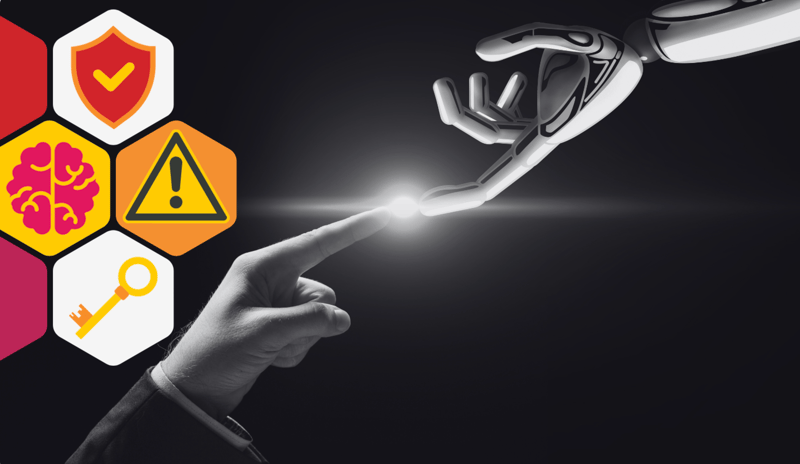
The future of work will have plenty of AI. It still needs grown-ups in the decision loop.
What is human-AI decision conflict?
Human-AI decision conflict occurs when a person and an AI-enabled system point in different directions. The AI may recommend, classify, approve, reject, prioritize, summarize, flag, or dismiss something. The human may disagree because they have context the system lacks, because the output seems incomplete, because the recommendation conflicts with policy, or because the decision carries consequences that require human accountability.
This can happen in cybersecurity, finance, HR, procurement, legal, operations, customer service, and almost every business function adopting AI. A security tool may score an alert as low priority while an analyst sees a pattern that deserves attention. An AI assistant may recommend sharing a file with a project group while the owner knows the document contains sensitive information. A hiring tool may rank candidates in a way that raises fairness concerns. A workflow may suggest approving a vendor request even though a relationship manager sees a mismatch in timing or tone.
The issue is not whether the human or the AI is “better.” That framing is tidy and mostly unhelpful. AI systems can process data at a speed and scale people cannot. Humans can understand context, ambiguity, accountability, ethics, politics, incentives, and the deeply underrated fact that sometimes the spreadsheet is technically correct and still missing the point.
The more useful question is how the organization wants decisions to work when human judgment and AI output do not align.
Why this is a human risk condition
Many organizations talk about “human-in-the-loop” as if putting a person somewhere near an AI system automatically creates meaningful oversight. In reality, the loop can be ceremonial. A person can click approve without understanding the recommendation, seeing the evidence, feeling permission to challenge, or having enough time to review. That is not oversight. That is workflow decoration.
Effective human oversight requires capability and conditions. The person needs to understand the decision they are reviewing. They need enough context to challenge the output. They need to know what the system can and cannot do. They need the authority to pause or escalate. They need a culture that will not punish them for slowing down a risky decision.
NIST’s AI Risk Management Framework gives organizations a useful structure because it treats AI risk as something to govern, map, measure, and manage over time. Its core functions are designed to support dialogue, understanding, and action around trustworthy AI systems. Human-AI decision conflict belongs inside that framework because disagreement between people and AI is exactly where governance becomes operational.
The OECD AI Principles also emphasize trustworthy AI that respects human rights, democratic values, and human-centred principles. That matters because human oversight is not just a technical check. It is part of keeping people accountable for decisions that affect other people, customers, systems, and the business.
For cybersecurity and human risk management, the condition becomes visible when employees are unsure what to do with AI disagreement. Do they defer to the model? Override it? Report it? Document it? Ask a manager? Call security? Ignore the feeling and keep the workflow moving?
If the answer depends on personality, seniority, or bravery, the control is weaker than it looks.
Where human-AI conflict shows up in real work
The most obvious examples sit in security operations, where AI can help classify alerts, summarize incidents, prioritize vulnerabilities, or detect anomalies. These are useful applications. They also create review challenges. If the tool says an alert is low priority but the analyst notices something unusual, what happens next? Is the analyst encouraged to investigate, or are they measured mainly on throughput?
In identity and access management, AI may help recommend permissions, flag risky behavior, or suggest access changes. That can improve consistency, but access decisions often require local context. A user’s formal role, project assignment, temporary responsibility, and actual business need may not fit neatly into the model’s understanding of normal.
In finance and procurement, AI may support vendor checks, invoice processing, fraud detection, contract review, or payment workflows. A recommendation may be technically plausible while missing a relationship detail or recent change. In these settings, disagreement can have immediate financial consequences.
In HR and workforce operations, AI may summarize employee cases, support policy interpretation, recommend learning paths, or flag behavioral patterns. Human review is essential because context, fairness, sensitivity, and privacy all matter. A tidy output can still be incomplete.
In everyday employee productivity, the conflict may be smaller but more frequent. An AI assistant says a file appears safe to share. A chatbot summarizes a data policy. A copilot drafts a response to a customer. An employee senses that the output is too broad, too confident, or too casual for the situation. The decision point is small, but those small decisions accumulate into organizational risk.
This is where human risk gets interesting. The problem does not always live in the model. Sometimes it lives in the handoff.
The three failure modes leaders should watch
Human-AI decision conflict tends to fail in three predictable ways.
The first is automatic deference. The employee accepts the AI output because the system is fast, confident, official, or usually correct. This is especially likely when the employee is busy, junior, uncertain, or operating in a culture where challenging tools feels like challenging the process itself.
The second is unstructured override. The employee rejects the AI output based on experience or instinct, but the decision is not documented, reviewed, or learned from. Sometimes this is exactly the right call. Sometimes it reveals bias, inconsistency, or a misunderstanding of the model. Either way, the organization loses a learning opportunity if overrides disappear into the workflow.
The third is escalation paralysis. The employee sees a conflict but does not know where to take it. They may not want to bother security, legal, IT, compliance, or a manager. They may assume someone else owns the system. They may think the issue is too small to report. The disagreement becomes private, and private disagreement is very hard to govern.
These failure modes can exist in the same organization at the same time. One team may overtrust AI. Another may ignore it. A third may escalate everything because nobody has defined what matters. The result is inconsistency, which is not a lovely foundation for risk management.
What good decision design looks like
Good human-AI decision design starts before the moment of disagreement. Employees need to know the role of the AI in the workflow. Is it drafting? Advising? Ranking? Flagging? Approving? Blocking? Acting on behalf of a user? Each role requires different expectations.
A drafting tool does not need the same governance as an access approval system. A recommendation engine does not carry the same risk as an agent that can trigger a workflow. A chatbot answering general questions should not be treated like an authoritative policy owner. Clarity about the AI’s role helps employees understand how much weight to give the output.
The next step is decision rights. Organizations should define who owns the final decision in high-impact workflows. If a human is accountable, that person needs the ability to review evidence, challenge the output, and pause the process. Accountability without authority is just stress with a job title.
Then comes escalation. Employees should know what counts as a concern, where to raise it, and how quickly it needs attention. A strange AI-generated summary may require a different path than a model output that could lead to a data disclosure, financial approval, access change, legal commitment, or safety issue.
Good design also includes documentation. When humans override AI, accept high-risk recommendations, or escalate concerns, those actions should create learning signals. Over time, leaders can see whether the AI is misunderstood, overtrusted, undertrusted, poorly integrated, or working well but poorly explained.
And yes, the interface matters. If the human reviewer sees only a recommendation and an approve button, the organization should not pretend it has designed meaningful oversight. People need the evidence behind the recommendation, the source of the data, known limitations, confidence indicators where appropriate, and an easy route to ask for help.
The AI and agentic risk angle
Agentic AI sharpens the issue because it can compress many decisions into one visible output. An agent may collect information, summarize it, compare options, draft an action, and present a recommendation. The human sees the polished result, not necessarily the steps underneath.
That creates a new kind of decision conflict. The employee may disagree with the final recommendation but not know which part of the agent’s process caused the concern. Was the source wrong? Was the instruction misunderstood? Did the agent over-prioritize speed? Did it miss a policy? Did it retrieve the wrong record? Did it act on outdated information?
CISA’s AI resources focus on secure and resilient AI adoption, including secure integration and secure-by-design principles for AI systems. Those principles matter for agentic workflows because the design of the system affects whether humans can provide meaningful oversight.
From a human risk perspective, agentic AI requires visible handoffs. Employees need to know what the agent did, what it is asking them to approve, what evidence supports the action, and what risks require escalation. Otherwise, the human becomes the final checkbox on a process they cannot meaningfully inspect.
That is not a human-in-the-loop strategy. That is a human-near-the-loop strategy, which is less reassuring than it sounds.
How to measure human-AI decision conflict
This condition can be measured more practically than many leaders expect. Start by identifying workflows where AI influences decisions with security, privacy, financial, legal, customer, workforce, or operational impact. Then look at what happens when humans and AI disagree.
Useful signals include override rates, escalation rates, review times, acceptance of AI recommendations, employee confidence in challenging AI outputs, and the quality of documentation around AI-assisted decisions. Surveys can reveal whether employees understand when AI is advisory, when it is authoritative, and when they are expected to take ownership.
Scenario-based testing can be especially valuable. Give employees realistic examples where AI output is plausible but incomplete. For instance, an AI summary misses a data handling rule, a tool marks a message as safe despite suspicious business context, or a workflow recommends access that no longer matches the user’s role. The goal is to see whether employees can identify the conflict and choose the right action.
Incident and near-miss reviews should also include AI decision questions. Did AI influence the decision? Did the human reviewer understand the output? Was there a chance to challenge it? Was escalation clear? Did the workflow support or discourage review?
Over time, these signals help leaders see whether AI is improving decision quality or creating quiet overreliance, confusion, or inconsistent judgment.
How to improve without making everyone afraid of AI
The tone matters. Employees should not hear that AI is dangerous and they are on their own. They should hear that AI is powerful, useful, and worth using well.
Organizations can help by creating plain-language decision guidance. Employees need examples of when to accept AI support, when to check source material, when to escalate, and when human judgment owns the final call. “Use AI responsibly” is a nice phrase. “Verify AI outputs before using them for customer data, access approvals, financial actions, legal commitments, or security decisions” is much more useful.
Training should include disagreement practice. Let people experience the moment where the AI sounds right but something is missing. Let them practice pausing, checking evidence, asking for help, documenting an override, or escalating a concern. People build confidence by rehearsing the behavior, not by reading a policy and hoping their future self remembers page nine.
Managers also need enablement. They will be the first stop for many AI questions, especially in business teams. Managers should know how to respond when an employee says, “The tool recommended this, but I am not sure.” That moment should be treated as healthy risk sensing, not indecision.
Finally, AI governance teams should treat employee disagreement as useful intelligence. If people are frequently challenging a system, the answer may be better training, better interface design, clearer boundaries, model improvement, or process redesign. The disagreement is not noise. It may be the signal.
How Cybermaniacs approaches human-AI decision conflict
At Cybermaniacs, we see human-AI decision conflict as part of the next generation of human risk management. It connects trust, verification, cognitive offloading, automation complacency, role clarity, escalation friction, AI governance, and operational resilience.
The work is not only to teach employees what AI is. It is to help organizations understand how AI changes decisions, where human judgment still matters, and what conditions help people act well when the tool and the human do not fully agree.
That takes an integrated approach: learning, simulations, nudges, advisory support, managed programs, measurement, and practical workflow guidance. Cybermaniacs helps organizations turn AI governance from policy language into observable behavior. We look at whether employees know when to trust, when to verify, when to challenge, and when to escalate.
This is also where services and advisory matter. Many organizations do not just need another module. They need help mapping the decision moments, interpreting the risk conditions, and building a practical program that fits how work actually gets done.
Human-AI decision conflict will not be solved by telling people to “keep a human in the loop.” The loop needs design. The human needs confidence. The organization needs evidence.
Practical takeaways for leaders
Human-AI decision conflict should be treated as a measurable risk condition, especially in workflows involving security, privacy, finance, access, legal, HR, vendor management, and customer impact.
Leaders should define the role of AI in each workflow. Employees need to know whether the tool is drafting, advising, ranking, approving, blocking, or acting. Different roles require different review expectations.
Decision rights should be clear. If a human owns the outcome, that person needs the authority, context, and time to review the AI output meaningfully.
Escalation should be easy. Employees should know where to take concerns when AI output seems wrong, incomplete, unsafe, biased, or inconsistent with policy.
Organizations should measure override behavior, escalation patterns, employee confidence, review quality, and decision outcomes. Human-AI disagreement can become an early warning signal if the organization knows how to listen.
FAQ
What is human-AI decision conflict?
Human-AI decision conflict happens when an AI system recommends, classifies, flags, approves, or summarizes something in a way that conflicts with human judgment, context, policy, or concern.
Why is human-AI decision conflict a cybersecurity risk?
It becomes a cybersecurity risk when employees are unsure whether to trust, challenge, override, or escalate AI outputs that affect access, data sharing, fraud detection, phishing response, vendor management, incident response, or other security-relevant decisions.
What does human oversight of AI mean in practice?
Human oversight means people have the authority, context, time, and confidence to review AI outputs and intervene when needed. It requires more than placing an approval button in front of a person.
How should employees respond when they disagree with AI?
Employees should check the source material, review the context, follow the organization’s decision guidance, and escalate when the output could affect money, access, sensitive data, legal commitments, customer impact, security, or safety.
How can organizations measure human-AI decision conflict?
Organizations can measure override rates, escalation rates, AI recommendation acceptance, employee confidence, review quality, incident patterns, and performance in realistic scenarios where AI output is plausible but incomplete or wrong.
How can companies improve human-AI decision-making?
Companies can improve human-AI decision-making by defining AI roles, clarifying decision rights, designing useful review interfaces, training employees on disagreement scenarios, enabling managers, and treating human challenges as valuable risk signals.
Closing thought
AI will make many decisions faster, better informed, and easier to manage. That is a good thing. The strongest organizations will be the ones that also know where human judgment belongs, especially when context is messy and the answer is not obvious.
When humans and AI disagree, the goal is not to crown a winner. The goal is to make sure the decision is understood, owned, and safe enough for the business to stand behind.
That is where human risk management becomes very real: not in the policy, not in the promise of the tool, but in the moment someone is allowed to say, “I want to check this before we move.”